

What if the sticker price on that pre-owned sedan is actually the least important number in your financial plan? Most Orlando drivers focus solely on the total cost, but a truly sustainable car buying budget is built on the monthly realities of life in Central Florida. You're likely already thinking about how to balance a reliable ride with your other expenses. It's completely normal to feel a bit uneasy about hidden costs like rising Florida insurance premiums or those daily I-4 tolls that seem to add up when you least expect them.
At Keys Motors - Orlando, we believe you deserve a clear path to ownership without the stress of being upsold or surprised by your monthly statement. This guide will help you master the math of vehicle ownership so you can step onto a lot with total confidence. We'll walk you through how to determine a concrete dollar amount for your target price, how your credit score influences your options, and how to factor in every ownership cost to ensure your next vehicle truly fits your lifestyle.
Key Takeaways
- Learn why a realistic car buying budget includes more than just the sticker price, factoring in Florida-specific costs like insurance and tolls.
- Master the 20/4/10 rule to ensure your down payment and monthly installments remain manageable and sustainable.
- Discover how choosing a pre-owned vehicle and utilizing a trade-in valuation can significantly lower your total financed amount.
- Follow a simple, step-by-step process to calculate an ideal monthly payment based on your actual take-home pay and fixed expenses.
- Gain the confidence to manage the financing process with transparent tools and local expertise tailored to the Orlando market.
Beyond the Sticker Price: Understanding the True Cost of Car Ownership in Florida
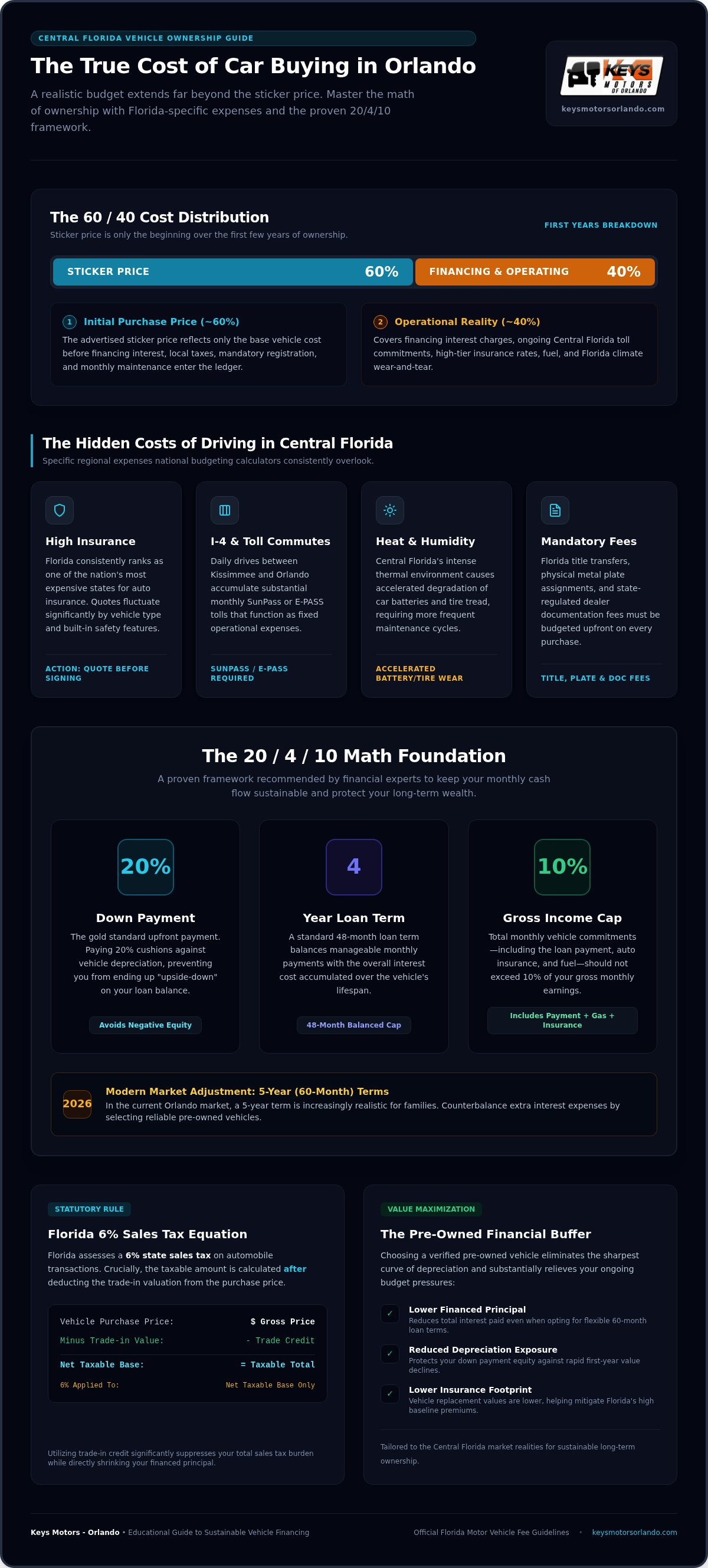
When you see a price tag on a pre-owned vehicle, it's easy to think that's the only number you need to hit. In reality, a successful car buying budget covers the purchase price, financing interest, and your monthly operating expenses. Think of the sticker price as just the beginning. It typically represents only about 60% of the true cost of vehicle ownership over the first few years of driving. By accounting for the other 40% now, you ensure your ride remains a source of freedom rather than a financial burden. Starting with a clear plan is the best way to maintain peace of mind on the road.
The Hidden Costs of Driving in Central Florida
Living in the Sunshine State brings specific expenses that national calculators often overlook. Florida consistently ranks as one of the most expensive states for auto insurance. We recommend getting a quote for the specific model you're eyeing before you sign. Premiums fluctuate based on vehicle type and safety features. Then, there's the I-4 commute. If you're driving between Kissimmee and Orlando daily, those SunPass or E-PASS tolls become a fixed monthly expense that belongs in your car buying budget. Finally, don't forget the weather. Our intense heat and humidity are notoriously tough on car batteries and tires. Budgeting for slightly more frequent maintenance helps you avoid being stranded in the afternoon sun.
Registration and Documentation Fees
Beyond the daily drive, Florida has specific requirements for getting your vehicle on the road legally. These are fixed costs that you should prepare for early in the process to avoid surprises at the dealership.
- Sales Tax: Florida charges a 6% sales tax on vehicle purchases. This is calculated based on the price after any trade-in value is deducted, which can help lower your tax burden.
- Title and Registration: If you're a new resident or transferring a plate, expect fees for the title transfer and the physical metal plate. These are state-mandated costs that apply to every driver.
- Dealer Documentation Fees: In the Orlando market, dealers charge a fee to process the required legal and administrative paperwork. At Keys Motors - Orlando, we prioritize transparency so you know exactly what these costs look like before you commit.
Starting with a comprehensive view of these numbers provides quiet confidence. You aren't just buying a car; you're securing your ability to move through Central Florida without financial stress. Taking the time to master these details now will pay off every time you get behind the wheel.
The Math of Car Buying: Using the 20/4/10 Rule as Your Foundation
Establishing a solid car buying budget doesn't have to be a guessing game. Many financial experts recommend the 20/4/10 rule as a reliable baseline for making a smart purchase. This framework helps you balance what you want with what you can actually afford without feeling "car poor" at the end of the month. It's a simple way to look at your finances and see if a specific vehicle fits into your long-term goals.
The first part of the rule suggests putting 20% down. This is often considered the gold standard because it helps you stay ahead of depreciation. By paying this amount upfront, you're less likely to end up "upside-down" on your loan, which is when you owe more than the car is worth. The "4" represents a four-year loan term. While longer loans are available, a 48-month term strikes a healthy balance between a manageable monthly payment and the total interest you'll pay over the life of the loan. Finally, the "10" means your total vehicle expenses, including insurance and fuel, shouldn't exceed 10% of your gross monthly income.
Adjusting the Rules for the 2026 Market
While the 20/4/10 rule is a great starting point, we know that life in Orlando has changed. In the current market, a five-year (60-month) loan is often more realistic for many families. If you choose a longer term, focus on reliable pre-owned vehicles to help offset the extra interest costs. At Keys Motors - Orlando, we make it easy to pre-qualify car loan Orlando options and see real numbers tailored to your situation. It's also helpful to consult the official Florida motor vehicle fee schedule to ensure your car buying budget accounts for every state-mandated registration and title cost from day one.
Calculating Your Debt-to-Income Ratio
Lenders look at more than just your income; they want to see your Debt-to-Income (DTI) ratio. This is a simple calculation you can do at home. Add up all your monthly debt obligations, like credit card minimums, student loans, and your projected car payment. Divide that total by your gross monthly income. Debt-to-Income (DTI) ratio is the percentage of your gross monthly income that goes to paying debts. Lenders generally prefer a DTI below 36% to ensure you aren't overextended. If your ratio is higher, you might consider a larger down payment or a more affordable pre-owned model. You can view our current inventory to find vehicles that align with your calculated budget and financial goals.
Maximizing Value: How Used Vehicles and Trade-Ins Stretch Your Budget
Stretching your car buying budget in the Orlando market often comes down to how you handle depreciation and your current vehicle. Choosing a pre-owned car is one of the most effective ways to get more features for your money. Since vehicles lose a significant portion of their value in the first few years, a used car allows you to let the previous owner take that financial hit. This "Depreciation Advantage" means you can often afford a higher trim level or a more reliable model than if you were looking at brand-new options.
Your current vehicle is also a powerful financial tool. In Florida, trading in your car offers a unique tax benefit that many drivers overlook. When you trade in a vehicle, you only pay the 6% sales tax on the difference between the trade-in value and the price of your next car. For example, if you're buying a car for $20,000 and your trade-in is worth $5,000, you only pay tax on $15,000. This effectively keeps more cash in your pocket. To ensure you aren't surprised by future maintenance costs, we always recommend inspecting used cars Orlando drivers trust by using a thorough checklist before finalizing your purchase.
New vs. Used Depreciation in Florida
The moment a new car leaves a lot, its value drops. In our local market, this decline can be even more pronounced due to high mileage from long commutes. We've found that a 3-year-old pre-owned vehicle is often the "budget sweet spot" because the steepest part of the depreciation curve has already passed. You can explore our deep dive into new vs used car depreciation Florida data to see exactly how these numbers play out over time. Using CFPB auto loan planning tools can also help you visualize how these value changes impact your long-term equity.
Turning Your Current Car into a Budget Tool
Think of your trade-in as a "hidden" down payment. A $5,000 trade-in value can lower your monthly payment by roughly $100, depending on your loan terms and interest rate. To get the highest possible offer in the Orlando market, take the time to clean your car thoroughly and gather all maintenance records. Having a clear service history shows that the car was well-cared for, which builds confidence during the valuation process. This simple preparation can significantly improve your car buying budget by reducing the amount you need to finance from the start.
Step-by-Step: Calculating Your Ideal Monthly Payment and Down Payment
Building a car buying budget requires a clear-eyed look at your actual cash flow. Instead of guessing what you can afford, follow a logical process to find a number that keeps your finances stable. This methodical approach removes the guesswork and gives you the confidence to talk numbers with a local advisor. It's about finding a balance that supports your lifestyle in Central Florida while protecting your long-term goals.
Start with your net monthly take-home pay. This is the amount that actually hits your bank account after taxes and deductions. Next, subtract your fixed monthly costs. Include your rent or mortgage, utilities, groceries, and the Florida auto insurance premiums we discussed earlier. Once those are cleared, set aside a maintenance buffer of $50 to $100 per month. This small reserve ensures you're ready for routine oil changes or tire rotations without dipping into your savings. Finally, use an online calculator to see how much car you can finance with the remaining surplus. This simple math ensures your vehicle remains a tool for your life rather than a source of stress.
Building Your Savings Goal for a Down Payment
Taking three to six months to save for a down payment provides significant leverage during the buying process. A larger upfront payment reduces the total amount you need to borrow, which often results in a lower interest rate and less interest paid over the life of the loan. While we previously mentioned that 20% is the gold standard, don't feel discouraged if that feels out of reach. We recommend aiming for at least $2,000 or 10% of the car price to give your loan a solid foundation. You can view our current inventory online to see how different price points align with your savings goals.
The Role of Credit Scores in Your Budget
Your credit score is a major factor in determining your monthly payment. A difference of just 50 points can change your monthly installment by $50 or more because of how interest rates are tiered. Before you start shopping in Kissimmee or Ocala, check your score through your bank or a free monitoring service. Knowing your standing ahead of time prevents surprises and helps you set realistic expectations. Many shoppers worry that checking their options will hurt their credit, but our pre-qualification process uses a "soft pull." This allows you to see your potential rates and build your car buying budget accurately without impacting your score.
Financing Your Future: How Keys Motors Simplifies the Orlando Buying Process
Finding a vehicle that fits your life shouldn't feel like a battle. At Keys Motors, we've built our reputation on East Colonial Drive by prioritizing transparent pricing over high-pressure tactics. While some local dealers hide behind "call for pricing" slogans, we provide the clarity you need to finalize your car buying budget before you even step onto our lot. Our goal is to act as your local expert, ensuring you feel supported at every turn of the purchasing process.
To make your financing as smooth as possible, we maintain strong partnerships with major lenders like Capital One. These relationships allow us to offer competitive rates that match your financial profile. You can also use our online inventory tools to filter vehicles by price, mileage, and body style. If you don't see exactly what you're looking for, our vehicle finder service is a favorite for Kissimmee and Ocala drivers. We'll do the heavy lifting to find a car that meets your specific needs and price point without the usual stress of a traditional search.
A Reassuring Path to Ownership
We take pride in our "Neighborly Advisor" approach. This means we focus on education rather than aggressive sales. We know that the paperwork can feel overwhelming, especially if you're a first time car buyer Orlando resident. Our team takes the time to walk you through every document, explaining the terms in plain English so you can sign with confidence. Additionally, every vehicle in our inventory undergoes a thorough pre-inspection. This commitment to quality provides long-term budget stability, as you won't have to worry about immediate, major repairs after your purchase.
Get Started Today from Home
You can begin your journey from the comfort of your living room. Our online pre-qualification tool gives you a clear look at your potential loan terms without impacting your credit score. It's a risk-free way to see how a specific monthly payment fits into your car buying budget. Once you have your numbers ready, we invite you to visit us in person or continue exploring our digital showroom. Taking that first step is easy when you have a reliable partner by your side. Browse our budget-friendly pre-owned inventory in Orlando today and see how simple the process can be.
Drive Forward with Confidence
Mastering your car buying budget is about more than just numbers; it's about securing your peace of mind on the Central Florida roads. By accounting for the "Florida Factor" like insurance and tolls, and using frameworks like the 20/4/10 rule, you've already taken the most important step toward a stable financial future. Remember that choosing a pre-owned vehicle and utilizing your trade-in value are powerful ways to keep your monthly payments manageable while avoiding the steepest part of the depreciation curve.
At Keys Motors, we're here to help you turn these calculations into a reality. Our team on East Colonial Drive specializes in transparent pricing models and expert financing assistance through partners like Capital One. We believe the car-buying process shouldn't be stressful for any member of our community. When you're ready to see how your budget translates into a reliable ride, we're here to guide you through every step of the journey.
Find your next vehicle within your budget at Keys Motors Orlando
Frequently Asked Questions
How much of my income should go toward a car payment?
Ideally, your monthly car payment shouldn't exceed 10% to 15% of your gross monthly income. This ensures you have enough remaining for other Orlando living expenses like housing and utilities. When building your car buying budget, remember that total ownership costs include insurance and fuel. Keeping your total vehicle expenses under 20% of your take-home pay is a safe way to protect your financial stability.
Is it better to have a larger down payment or a shorter loan term?
Both options offer long-term financial benefits, but a larger down payment is often the most effective way to lower your monthly costs. It helps you avoid being "upside-down" on your loan, where you owe more than the car's value. A shorter term, such as 48 months, reduces the total interest you'll pay over time. If you can manage both, you'll maximize your savings and build equity faster.
What are the most common hidden costs of buying a car in Orlando?
Beyond the sticker price, you must account for Florida's 6% sales tax, title transfer fees, and registration costs. Local drivers also face daily SunPass or E-PASS toll expenses on the I-4 corridor. Additionally, the intense Central Florida heat leads to faster wear on batteries and tires compared to other regions. Factoring these into your car buying budget prevents surprise expenses after you drive off the lot.
Can I buy a car in Florida with a low credit score?
Yes, you can find financing options even if your credit score isn't perfect. We partner with lenders like Capital One to help buyers in various financial situations secure reliable pre-owned vehicles. While a lower score might result in a higher interest rate, making a larger down payment can help offset your monthly installments. We recommend using our online pre-qualification tool to see your real options with a soft credit pull.
How does a trade-in affect my car buying budget?
A trade-in acts as a direct down payment, reducing the total amount you need to finance for your next vehicle. In Florida, trading in also provides a significant tax advantage. You only pay the 6% sales tax on the price difference between your new car and your trade-in value. This "hidden" saving can keep hundreds of dollars in your pocket, making it much easier to stay within your target price range.
Should I include insurance in my monthly car budget?
You should absolutely include insurance because Florida premiums are often higher than the national average. Since insurance is a mandatory monthly expense, excluding it would give you an unrealistic view of what you can actually afford. We suggest getting a quote for the specific model you're considering before finalizing your purchase. This ensures your total monthly commitment remains comfortable and sustainable for your Central Florida lifestyle.
How much should I save for car maintenance each month in Florida?
A safe baseline is to set aside $50 to $100 per month for a maintenance buffer. This fund covers routine oil changes, brake pads, and the accelerated tire wear caused by hot Orlando pavement. Having this money ready prevents you from needing to use credit cards for unexpected repairs. It's a simple habit that adds an extra layer of security and reliability to your vehicle ownership experience.


