
Imagine finding a great-looking SUV on a lot near East Colonial Drive, only to wonder if those clean carpets are hiding the damp history of a Central Florida storm. It's a common fear that can turn an exciting upgrade into a stressful ordeal. When you're inspecting used cars in Orlando, the pressure to make a quick decision often clashes with the anxiety of buying a vehicle "as-is."
We understand that you want a dependable vehicle for your daily commute without the fear of hidden mechanical issues or confusing sales talk. That's why we've created this expert-led guide to help you master the inspection process. You'll gain the tools to spot a reliable car and the confidence to walk away from a bad deal.
In the following sections, we provide a step-by-step DIY checklist tailored for the local market. We'll cover how to identify flood damage, what to listen for during a road test, and when it's worth spending the $150 to $250 for a professional mobile inspection. By the end, you'll have a clear path to a vehicle that fits your budget and your lifestyle.
Key Takeaways
- Identify Florida-specific red flags, such as hidden flood damage and sun-related wear, to ensure your next vehicle is built to last in the local climate.
- Follow a practical DIY checklist for inspecting used cars Orlando to catch obvious mechanical and cosmetic issues before committing to a purchase.
- Learn how to conduct a professional-grade test drive by evaluating engine sounds and braking performance on Central Florida roads.
- Protect yourself from financial loss by verifying VIN locations and understanding how Florida "Rebuilt" titles impact a car's actual market value.
- Decide with confidence whether to pay for a third-party mechanic or save time by choosing a vehicle from a pre-inspected inventory.
Why Inspection is Critical in the Orlando Used Car Market
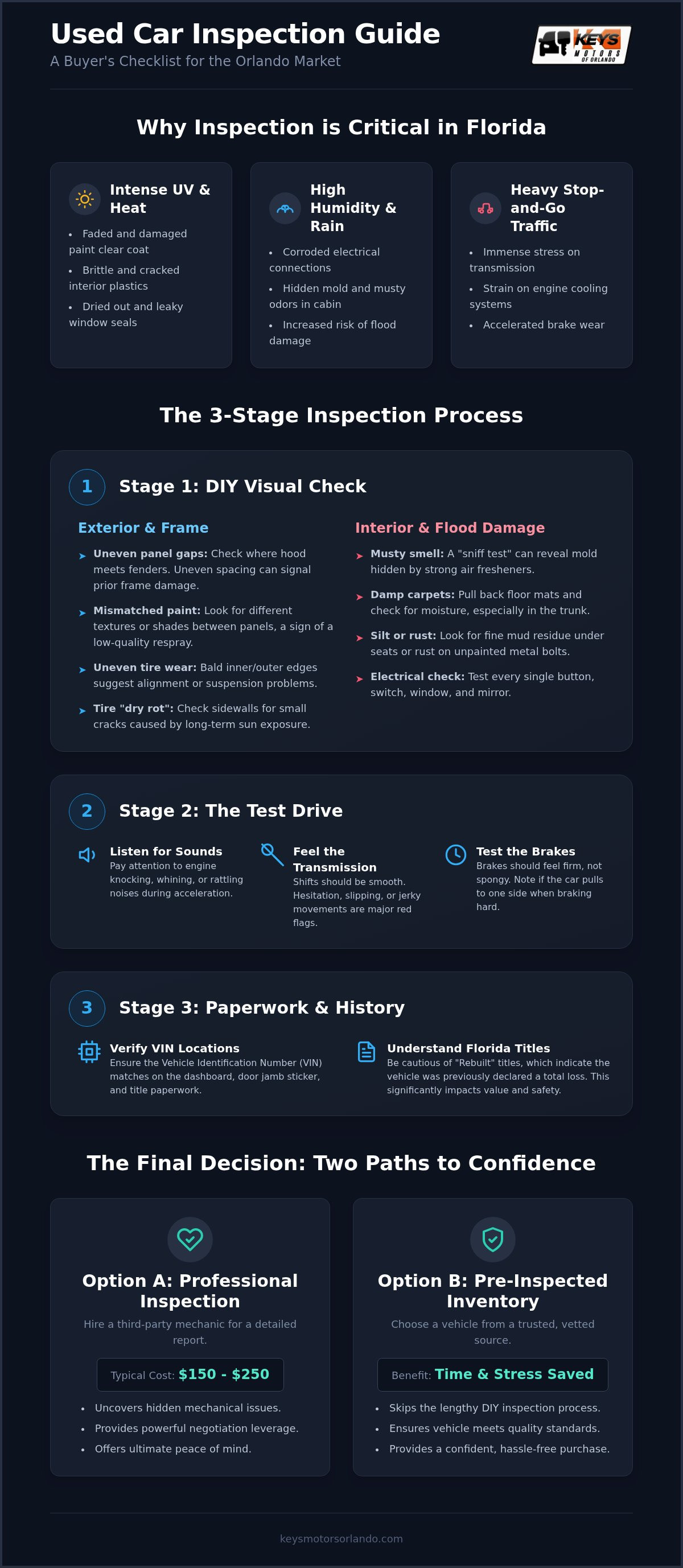
Many buyers believe the "Florida car" myth, which suggests that vehicles from the Sunshine State are inherently better because they never see road salt or snow. While it's true that we don't deal with rusted floorboards from winter slush, our environment presents unique challenges. Tropical humidity and intense heat can be just as damaging as a northern winter. When you're inspecting used cars Orlando, you must look past the shiny exterior to find the hidden effects of the local climate.
A professional pre-purchase inspection serves as your most powerful tool during the buying process. It shifts the dynamic from a simple sales transaction to a transparent evaluation of value. Instead of hoping the car is reliable, you'll have a documented report to guide your decision. This report often becomes a central part of your price negotiations, as it identifies upcoming maintenance needs that might not be obvious to the untrained eye. Even a simple 30-minute visual check can reveal red flags that save you thousands of dollars in future repairs. At Keys Motors - Orlando, we believe that transparency is the foundation of a good deal.
The High Stakes of Central Florida Driving
Our weather is tough on vehicles. Intense UV rays act like a slow-motion oven, baking the clear coat on the paint and making interior plastics brittle. Over time, these rays can cause window seals to dry out and crack, leading to leaks during our frequent afternoon downpours. High humidity levels create a perfect environment for electrical corrosion and cabin mold, which are often expensive and difficult to fix.
Local driving conditions also take a toll. The average Orlando commuter travels about 27 miles each way to work, often in heavy stop-and-go traffic on I-4 or the 408. This constant idling and braking puts immense stress on the transmission and cooling systems. A car that looks great in a driveway might have an engine that has spent hundreds of hours straining in 95-degree heat. We focus on these specific local factors to ensure you don't inherit someone else's maintenance backlog.
When to Walk Away Immediately
Some issues simply aren't worth the investment. Major deal breakers include signs of structural frame damage, evidence of previous flooding, or a transmission that slips during a test drive. If the seller seems hesitant to let you perform a thorough check, trust your instincts. A "gut check" is often your best defense against a bad deal; if a price seems too good to be true, there's usually a hidden reason why.
It's also vital to understand your legal standing. Florida's Lemon Law does not cover used cars unless the vehicle is still within its original 24-month rights period from the initial purchase. Since most used vehicles are sold "as-is," the responsibility for inspecting used cars Orlando falls entirely on you. Taking the time to verify the car's condition now is the only way to guarantee peace of mind after you drive off the lot.
Stage 1: The DIY Visual Inspection and Florida Red Flags
Before you ever turn the key, your eyes and nose can tell you a lot about a vehicle's history. Start with a slow walkaround in bright, natural light. Look closely at the paint on every panel. If the front fender looks slightly more textured or a shade darker than the door, it likely indicates a previous accident and a low-quality respray. Check the gaps between body panels, such as where the hood meets the fenders. These gaps should be uniform; uneven spacing often signals that the car's frame was pulled or parts were replaced after a collision.
Tire health is another window into the car's past. Don't just check the tread depth; look for uneven wear patterns. If the inside edge of a tire is bald while the outside looks new, you're likely looking at alignment or suspension issues. In our local climate, rubber degrades quickly. Check the sidewalls for "dry rot" or small cracks, which are common when inspecting used cars Orlando that have spent years parked in the direct sun. If you want to avoid the stress of these initial checks, you can always explore our pre-inspected inventory of cars and SUVs.
Finally, perform a "sniff test" inside the cabin. A strong scent of air freshener or a lingering musty odor can be a tactic to hide mold. Test every electronic component. Roll the windows up and down, adjust the power mirrors, and cycle through the infotainment menus. Electrical gremlins are notoriously difficult and expensive to chase down later.
Spotting Hurricane and Flood Damage
Orlando's storm history means you must be vigilant about water damage. Pull back the carpet in the footwells and look for silt, sand, or rust on the seat bolts. These are places a detailer might miss. Open the hood and inspect the crevices of the engine bay for a "high-water mark" of dried mud. Remember that a clean history report isn't a guarantee. Some owners choose not to report flood damage to insurance to keep the title "clean," making your physical inspection even more vital. For detailed guidance on titles and private sales, refer to the Florida Department of Highway Safety and Motor Vehicles.
The All-Important AC System Check
A functional air conditioner is a non-negotiable requirement for Central Florida driving. Start the car and let it idle with the AC on the highest setting for at least ten minutes. The air should stay ice-cold even while the car isn't moving. If it only gets cold once you start driving, the cooling fan or the compressor may be failing. Listen for loud clicks or whistling sounds from the vents. Be wary if a seller claims the system "just needs a simple recharge." In most cases, that's a sign of a significant leak in the evaporator or condenser that could cost a fortune to repair.
Stage 2: Mastering the Test Drive on Orlando Roads
The test drive is your best opportunity to move beyond a visual check and feel how the vehicle actually performs. Always insist on a cold start. If the engine is already warm when you arrive, the seller might be hiding a rattle or a rough idle that only happens when the car is first cranked. Watch the exhaust as the car starts up; blue smoke indicates burning oil, while thick white smoke suggests a potential head gasket issue. These sensory details are vital when inspecting used cars Orlando drivers have used for their daily commutes.
Once you're on the road, pay close attention to the braking system. Find a safe, quiet street to test the brakes at both low and high speeds. If the steering wheel shakes or the pedal pulses under your foot, the rotors are likely warped. The car should stop in a straight line without pulling to one side. Similarly, the transmission should engage smoothly. If you feel a "thud" when shifting into gear or notice the engine revving without the car accelerating, the transmission is likely slipping. Following FTC consumer advice, always take your time during this phase to ensure every component works as promised.
Don't forget to test the suspension and steering on varied surfaces. Driving over uneven pavement or a few speed bumps will reveal knocks or clunks that indicate worn struts or bushings. The steering should feel tight and responsive, with no "dead zone" in the center. If the car wanders or feels loose, it may need expensive front-end work that should be factored into your final offer.
The I-4 Simulation: High-Speed Stability
A vehicle might feel perfect at 30 mph but reveal major flaws at highway speeds. Take the car onto a highway like I-4 or the 417 to reach 65-70 mph. Listen for excessive wind noise or whistling, which often points to the dry-rotted door seals mentioned earlier. Pay attention to the temperature gauge. Sustained high-speed driving in the Florida heat will quickly reveal a failing water pump or a clogged radiator. Ensure the car has enough merging power to handle the aggressive pace of Orlando traffic safely.
The Parking Lot Maneuvers
Finish your drive in a flat, open parking lot. Turn the steering wheel all the way to the left and right while moving slowly. A clicking sound usually means the CV joints are worn out, while a high-pitched whine suggests the power steering pump is struggling. This is also the perfect time to test the reverse camera and parking sensors. Before you shut the engine off, let it idle for a minute. Step out and look under the front of the car for any fresh fluid leaks that may have appeared once the systems reached full operating temperature.
Stage 3: Paperwork, VIN Checks, and Florida History
While the physical drive is crucial, the car's "paper trail" is just as important for your peace of mind. Start by verifying the Vehicle Identification Number (VIN) in multiple spots. Check the plate on the driver's side dashboard and the sticker on the driver's side door jamb. You should also look for the VIN stamped on the engine firewall or under the hood. If these numbers don't match exactly, it is a major red flag for potential fraud or a major unreported accident. This level of detail is essential when inspecting used cars Orlando sellers are offering privately.
Be particularly cautious with Florida title brands. A "Salvage" title indicates the vehicle was declared a total loss by an insurance company. A "Rebuilt" title means the car was repaired and passed a state inspection. While these vehicles often have lower price tags, they carry higher risks and are much harder to finance or insure. Always cross-reference the odometer reading with the vehicle history report. If the mileage on the dashboard is lower than what was recorded at a service visit two years ago, the odometer has likely been tampered with. Finally, check for open safety recalls. These can affect your ability to register the car and, more importantly, your safety on the road.
Reading Between the Lines of History Reports
A history report is only as good as the data entered into it. Look for frequent ownership changes in short periods, which often suggests a "lemon" that owners keep trying to offload. Ideally, you want to see consistent maintenance entries from local Orlando service centers. This proves the previous owner took the Florida heat seriously. Understanding this history is vital because it directly impacts your vehicle's future value. You can learn more about how these factors play out in our guide to New vs. Used Car Depreciation in Florida.
Verifying Ownership and Liens
Confirm that the person selling the car actually has the legal right to do so. Ask to see the seller's identification and compare it to the name printed on the title. If a lienholder is listed on the document, the loan must be paid off before the title can be legally transferred to you. Buying a car with an undisclosed lien puts you at risk of having the vehicle repossessed by the original lender. Having a clear, unencumbered title also ensures a smooth experience if you decide on trading in a car with a loan later on.
If you prefer a simpler path, we invite you to browse the inventory at Keys Motors - Orlando, where the paperwork and inspections are already handled for you. We provide a vetted pre-owned inventory to ensure every vehicle we sell meets our high standards for quality and legal transparency.
The Final Verdict: Professional Inspection vs. Pre-Inspected Inventory
Once you have gathered your DIY findings and completed a test drive, you face the final hurdle: deciding if you need a professional second opinion. If you are buying from a private seller, spending $150 to $250 for a mobile mechanic's pre-purchase inspection is a necessary safeguard. It is important to request a comprehensive mechanical inspection rather than a basic safety check. While a safety check verifies that the lights and wipers work, a comprehensive evaluation looks at engine compression, diagnostic codes, and transmission health to ensure no hidden failures are waiting for you.
At Keys Motors - Orlando, we aim to remove this logistical stress entirely. We take over the responsibility of inspecting used cars Orlando buyers want by performing these rigorous checks before any vehicle is ever listed for sale on East Colonial Drive. By choosing a pre-vetted inventory, you avoid the back-and-forth of scheduling with third-party mechanics and the risk of paying for an inspection on a car that turns out to have major flaws. Our goal is to provide a transparent starting point where the heavy lifting is already done for you.
Why a Trusted Dealer is Your Best Inspection Tool
Relying on an established local partner offers more than just a mechanical guarantee; it provides a relationship built on community trust. Keys Motors - Orlando prioritizes honest disclosures and market-based pricing to ensure you feel supported throughout your journey. To see how this fits into the bigger picture of your purchase, our Ultimate Guide to Buying Used Cars in Orlando offers additional context on the local market. This approach allows you to focus on finding the right fit for your lifestyle while we handle the technical verification and financing details.
Next Steps: From Inspection to Ownership
After you are satisfied with the vehicle's condition, the transition to ownership should be smooth and predictable. This involves finalizing the Florida DMV paperwork and ensuring the title transfer is handled correctly without any hidden lien issues. We invite you to explore the Keys Motors - Orlando inventory to see the standard of quality we maintain for every car, truck, and SUV. When you are ready to move forward, make sure you have your driver's license, proof of insurance, and any trade-in documents ready to go. We are here to make your next car purchase a stable, rewarding experience.
Your Path to a Reliable Local Ride
Choosing your next vehicle should be an exciting milestone, not a source of anxiety. You now have a solid foundation for inspecting used cars Orlando, from spotting subtle paint mismatches to evaluating engine health during a high-speed test drive on I-4. Remember that a clear title and a documented history are just as vital as a cold AC system. These steps protect your budget and ensure your safety on Central Florida roads.
While a DIY inspection is a great start, you don't have to navigate this process alone. We serve the Orlando, Kissimmee, and Ocala communities with a commitment to honesty and ease. Our team provides transparent market-based pricing and fast online financing pre-qualification to make your purchase as straightforward as possible. We've already performed the rigorous checks so you can focus on the joy of driving your new car.
Browse our pre-inspected used car inventory in Orlando today!
You have the knowledge to make a smart choice. We're here to support you whenever you're ready to take the next step toward your ideal car and a stress-free ownership experience.
Frequently Asked Questions
Is it worth paying for a pre-purchase inspection in Orlando?
Yes, paying for an independent inspection is one of the smartest investments you can make. In the Orlando area, a professional mobile mechanic typically charges between $150 and $250 for this service. This small upfront cost can save you thousands of dollars by identifying hidden mechanical issues or structural damage. When you are inspecting used cars Orlando sellers offer as-is, having an expert report gives you the leverage to negotiate a fair price.
How can I tell if a used car has flood damage from a Florida hurricane?
Look for silt or sand in hidden crevices, such as under the spare tire or inside the glovebox. Check for rusted seat bolts and a "high-water mark" of dried mud on the engine firewall. A musty smell or an overly strong scent of air freshener are also major red flags. Since hurricane damage is often hidden to keep a title clean, these physical signs are frequently more reliable than a history report.
What are the most common mechanical issues for cars in Central Florida?
Heat and humidity cause the most frequent problems in our region. You will often see dry-rotted tires, cracked window seals, and premature battery failure due to the 95-degree summer temperatures. Cooling systems and transmissions also face extreme stress in stop-and-go I-4 traffic. Frequent tropical rain can lead to clogged sunroof drains and electrical corrosion, so always check for damp carpets in the footwells during your initial walkaround.
Should I trust a Carfax report alone when inspecting a used car?
No, a history report should only be your starting point. While these reports track major accidents and title brands, they don't show repairs paid for in cash or recent damage that hasn't reached the database yet. A clean report doesn't guarantee the car is mechanically sound today. Physical inspecting used cars Orlando is the only way to confirm current tire wear, engine noises, or the actual condition of the interior electronics.
Can I take a used car to my own mechanic before buying it from a dealer?
Yes, any reputable dealer should allow you to have a third-party inspection performed. It is a standard part of the professional buying process that builds long-term trust between the buyer and seller. If a seller refuses this request, consider it a significant red flag and be prepared to walk away. At Keys Motors, we prioritize transparency and have already pre-inspected our inventory to save you time and provide immediate peace of mind.
What does a "Rebuilt Title" mean in Florida, and should I buy one?
A "Rebuilt Title" means the vehicle was previously declared a total loss but has since been repaired and passed a state safety inspection. While these cars are significantly cheaper, they have much lower resale value and can be difficult to finance or insure. We generally recommend sticking to clean-titled vehicles for better long-term stability and easier trade-ins. Buying a rebuilt car often leads to unexpected costs that outweigh the initial savings.
How long should a proper used car test drive last?
Aim for a test drive that lasts at least 20 to 30 minutes. This duration allows the engine to reach full operating temperature and reveals issues that might not appear during a quick trip around the block. You need enough time to test the car at highway speeds on roads like the 417 and in heavy traffic. This window ensures you can evaluate the AC's consistency and check for fluid leaks once the engine is warm.
What specific AC issues should I look for in an Orlando used car?
Test the air conditioning while the car is idling in a parking lot. If the air only gets cold when the vehicle is moving, the cooling fan or compressor may be failing. Listen for loud clicking or whistling sounds coming from the vents. In Orlando's humidity, the system must blow ice-cold air within a few minutes. Avoid any car where the seller claims it just needs a simple recharge, as this usually hides a very expensive leak.


