

Did you know that the national average to own and operate a new vehicle has climbed to $12,863 per year? For many of our neighbors, the actual cost of owning a car Florida drivers face feels even steeper due to our unique local conditions. Between insurance rates that rank among the highest in the country and the relentless sun that wears down batteries in half the usual time, your monthly budget can quickly become a source of stress. It's tough to plan for the future when costs seem to shift with the humidity.
We agree that you shouldn't have to guess about your transportation expenses. You deserve to know exactly where your money is going. In this 2026 budgeting guide, we'll pull back the curtain on the "Sunshine State Premium." We promise to provide you with a clear, step-by-step breakdown of Florida-specific fees, insurance realities, and heat-related maintenance. Keys Motors - Orlando is here to guide you through the process, ensuring you have the knowledge to build a monthly budget with total confidence and quiet peace of mind.
Key Takeaways
- Identify the specific "Day One" expenses unique to our state, including the $225 initial registration fee and how local sales tax caps apply to your purchase.
- Calculate a realistic monthly budget by factoring in the five pillars that define the true cost of owning a car in Florida.
- Prepare for the "Florida Heat Tax" with maintenance strategies that protect your battery and tires from the effects of our intense tropical climate.
- Learn why choosing a pre-owned vehicle is often the most effective way to bypass heavy depreciation and keep your long-term ownership costs low.
- Gain the confidence to shop transparently by focusing on the total out-the-door price and the benefits of securing pre-qualification before you visit a lot.
Calculating the Total Cost of Car Ownership in Florida
Many buyers focus only on their monthly loan payment. While that's a big piece of the financial puzzle, it doesn't reflect the full cost of owning a car Florida drivers actually face. To get a clear picture, you need to look at the Total Cost of Ownership (TCO). This concept includes every dollar you'll spend from the moment you drive off the lot until you eventually trade in or sell the vehicle years later.
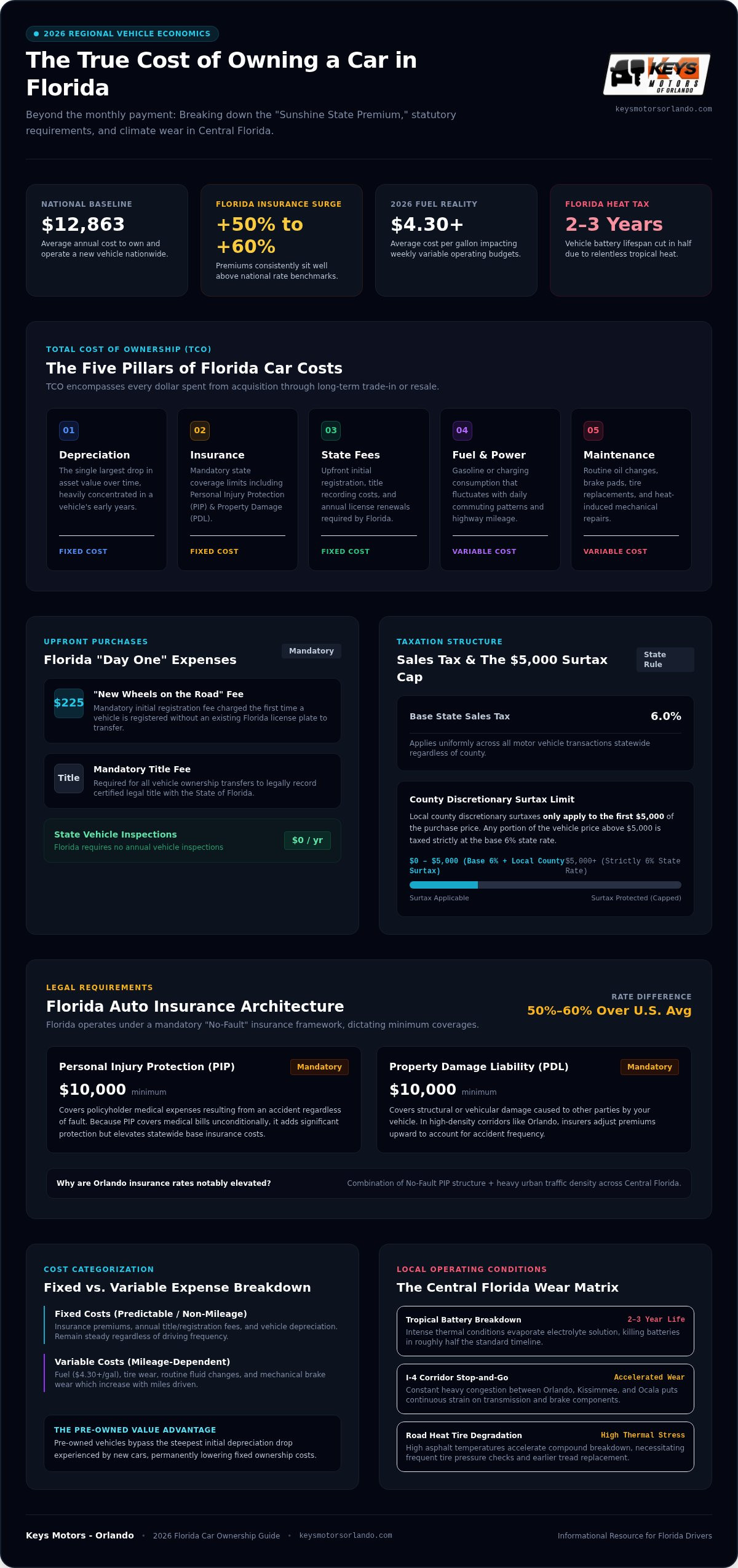
In 2026, Florida presents a unique financial landscape. We don't have annual state vehicle inspections, which saves a bit of time and money. However, those savings are often swallowed by insurance premiums that sit 50% to 60% above the national average. When you add in the intense tropical heat that kills batteries in just two or three years, the "Sunshine State" premium becomes very real. National data shows the average cost to own a new vehicle is now $12,863 per year, but local factors often push that higher for our residents.
The five pillars of Florida car costs are:
- Depreciation: The loss in value over time.
- Insurance: PIP and property damage requirements.
- Fees: Initial registration and annual title costs.
- Fuel: Gasoline or electricity expenses.
- Maintenance: Repairs and routine service like oil changes.
The Difference Between Fixed and Variable Costs
Understanding car ownership expenses requires splitting them into two categories. Fixed costs stay steady regardless of how much you drive. These include your insurance premiums, annual registration fees, and depreciation. This is where pre-owned vehicles offer a massive advantage. Because a used car has already experienced its steepest drop in value, your fixed cost of depreciation is significantly lower than if you bought a brand-new model. It's a simple way to keep more money in your pocket.
Variable costs fluctuate based on your mileage. Fuel is the most obvious example, but maintenance also falls into this category. The more you drive, the more often you'll need oil changes, tires, and brake pads. In 2026, with gas prices averaging over $4.30 per gallon, these variable costs can impact your weekly budget quickly.
Why a Realistic Budget Matters in Orlando
If you live in Central Florida, a reliable vehicle isn't a luxury. It's a necessity for the daily I-4 commute or navigating the growing neighborhoods in Kissimmee and Ocala. Constant stop-and-go traffic in these areas increases wear on your transmission and brakes. This can lead to unexpected repair bills if you haven't planned ahead. Local traffic patterns make your choice of vehicle even more important for long-term reliability.
We want to help you avoid financial surprises. Learning how to build a realistic car buying budget in Orlando is the first step toward stress-free ownership. By accounting for the local premium early on, you can choose a vehicle that fits your lifestyle without straining your bank account. Keys Motors - Orlando is dedicated to ensuring you feel supported and confident in your purchase.
Florida-Specific Fixed Costs: Insurance, Taxes, and Fees
When you first purchase a vehicle or move to the state, you'll encounter upfront expenses that often catch buyers off guard. The most significant is the "New Wheels on the Road" fee. This is a $225 initial registration fee charged the first time you register a vehicle in Florida without a license plate to transfer. Understanding these fixed expenses is vital when calculating the true cost of owning a car Florida residents must manage every year.
Sales tax also plays a major role in your initial budget. Florida imposes a base 6% state sales tax on all motor vehicle purchases. Many counties add a local discretionary surtax, but there's a helpful limit for your wallet. This local surtax only applies to the first $5,000 of the purchase price. Any amount above that threshold is taxed only at the 6% state rate. The Title Fee is a mandatory cost for all Florida transfers, ensuring the legal ownership of your vehicle is properly recorded with the state.
Navigating Florida Auto Insurance Requirements
Florida is a no-fault state, which directly impacts your monthly premiums. You are legally required to carry a minimum of $10,000 in Personal Injury Protection (PIP) and $10,000 in Property Damage Liability (PDL). Because PIP covers your medical bills regardless of who is at fault, it adds a layer of protection but also contributes to our higher-than-average rates. If you live in Orlando, you'll likely see higher quotes due to heavy traffic density and frequent accidents on roads like I-4. To keep these costs manageable, consider choosing a used vehicle with high safety ratings. You can also find a pre-owned car that is known for being "insurance-friendly" to help lower your annual commitment.
Registration and Plate Fees in 2026
After the initial setup, you'll face annual renewal costs. These are based on the weight of your vehicle. For a standard passenger car weighing between 2,500 and 3,499 pounds, expect to pay around $36 per year. Heavier SUVs and trucks will cost slightly more. You can view a full breakdown of these charges on the official schedule of Florida motor vehicle registration fees to see how they apply to your specific vehicle.
If you want to personalize your ride, Florida offers a wide variety of specialty plates, like the popular "Endless Summer" design. These usually carry an additional annual fee ranging from $15 to $25. One of the best ways to save money is to transfer an existing Florida plate from your old car to your new one. This simple step allows you to skip that $225 initial registration fee entirely, making your transition to a newer vehicle much more affordable.
Variable Operating Costs: Fuel, Tolls, and the "Heat Tax"
While fixed costs like registration and insurance provide a baseline, your variable expenses change based on how much you drive. In 2026, the cost of owning a car Florida residents face is heavily influenced by daily habits and the local environment. Florida's geography offers a slight advantage because our flat terrain requires less effort from your engine than hilly regions. However, this benefit is often canceled out by the heavy idling required during Orlando's rush hour traffic. Constant stop and go driving, combined with a high AC load, can reduce your fuel economy by 5% to 25% during the peak of summer.
According to AAA's annual Your Driving Costs study, fuel and maintenance are major contributors to the total expense of keeping a vehicle on the road. In Florida, these costs are amplified by our unique climate. With regular gasoline averaging around $4.33 per gallon in late 2026, even a small drop in efficiency from sitting on the 408 or I-4 can add up to hundreds of extra dollars per year.
Maintenance Costs Driven by the Florida Climate
In the automotive world, we often talk about the "Florida Heat Tax." This isn't a government fee, but a reality of how our weather treats your car. Our intense UV index and road surface temperatures, which frequently top 130 degrees, cause tires to suffer from dry rot and accelerated tread wear. You'll likely need to replace tires more often than drivers in cooler states. Similarly, car batteries in Florida typically fail every 24 to 36 months because the heat evaporates internal fluids. Finally, your air conditioning system is your most critical component. It works harder here than anywhere else, so keeping up with refrigerant levels and cabin filters is essential for both comfort and avoiding expensive compressor repairs.
Central Florida Toll Budgeting
If you live in Kissimmee or Ocala and commute into Orlando, tolls are a non-negotiable part of your budget. Highways like the 408, 417, and 528 are essential for moving through the region efficiently. For a daily commuter, toll expenses can easily reach $80 to $120 per month. Using a SunPass or E-PASS transponder is the smartest way to manage this, as these accounts provide an automatic 25% discount compared to "Pay by Plate" rates. Additionally, you should factor in the cost of I-4 Express lanes. During peak 2026 traffic, these lanes use dynamic pricing that can fluctuate based on congestion, making them a helpful but variable addition to your monthly travel spending.
The Used Car Advantage: Mitigating Depreciation
While we've discussed immediate expenses like registration and tolls, depreciation remains the single largest "hidden" expense for any vehicle owner. In 2026, a new car loses a significant portion of its value the moment it leaves the lot. For those looking to minimize the total cost of owning a car Florida drivers must manage, buying a pre-owned vehicle is a powerful financial move. By selecting a model that is just three years old, you avoid the steepest part of the value curve while still enjoying a modern, reliable machine.
Beyond the lower purchase price, used cars offer a secondary benefit for your monthly budget. Because insurance premiums are partly based on the current market value of the vehicle, insuring a pre-owned car often costs less than insuring its brand-new counterpart. This helps offset the high premiums common in Central Florida. You can explore the specific math behind these savings in our guide to new vs. used car depreciation in Florida.
Why Used Cars Are the Smartest Choice in 2026
Modern engineering has extended the life expectancy of vehicles far beyond what was common a decade ago. A car with 60,000 or even 100,000 miles is no longer at its "end"; it often has years of reliable service left if maintained properly. Choosing a used model also allows you to afford higher trim levels. You can get advanced driver-assistance systems and safety features that might be out of reach on a new car's base model. At Keys Motors - Orlando, we provide pre-inspected inventory to ensure every vehicle is ready to handle local driving conditions, helping you avoid the unexpected repairs often associated with unverified private sales.
Resale Value for Florida Drivers
Your vehicle is an investment, and protecting its resale value is key to long-term financial health. In the Orlando market, brands known for durability tend to hold their value best. To maximize your return when it's time to trade in, keep meticulous service records. Documenting your oil changes and cooling system maintenance proves to future buyers that you protected the engine from the harsh tropical heat. If you're navigating this process for the first time, our 2026 Orlando first-time car buyer guide provides a step-by-step checklist for making a smart purchase.
Ready to explore your options? Browse our current pre-owned inventory to find a vehicle that balances quality with long-term value.
Strategic Planning: Lowering Your Monthly Commitment
Take control of your budget before you ever step foot on a dealership lot. One of the most effective ways to manage the cost of owning a car Florida residents face is to secure pre-qualification for a loan. This step allows you to lock in an interest rate based on your credit profile, giving you a clear baseline for your negotiations. At Keys Motors, we believe in a transparent partnership. We work with reliable lenders to help you understand your options upfront, ensuring there are no surprises when it's time to sign.
Avoid the common mistake of shopping based only on a monthly payment. Dealers can often manipulate a monthly figure by extending the loan term, which actually increases the total cost of owning a car Florida drivers pay over the life of the vehicle due to interest. Instead, focus on the "Out-the-Door" price. This figure includes the vehicle cost, taxes, and those state fees we discussed earlier. Knowing this total allows you to compare offers accurately and stay within your financial comfort zone.
Financing Strategies for Central Florida
A larger down payment is a powerful tool in our local market. By putting more money down upfront, you can offset those initial "Day One" expenses like the $225 registration fee. It also reduces the total amount you need to finance, which lowers your monthly commitment. While we offer straightforward financing options, we also encourage you to check rates at local Orlando credit unions. Comparing these options ensures you get a deal that fits your life. For a deeper look at your choices, check out our Orlando car loan guide.
Final Checklist Before You Sign
Before you finalize any deal, perform your due diligence. In Florida, it's vital to check a vehicle history report for flood damage, especially given our history of tropical storms. A car that looks perfect on the outside could have hidden electrical issues from rising water. We also recommend bringing a list of 21 essential questions for car dealers to ensure you've covered every detail. Finally, review the contract for hidden "dealer add-ons" like nitrogen-filled tires or window etching. These items can quietly inflate your total investment without adding significant value to your driving experience.
Drive Confidently with a Florida-Ready Budget
Owning a vehicle in the Sunshine State doesn't have to be a financial guessing game. By accounting for the unique Florida "heat tax" and navigating our state-specific fees with a clear plan, you can take total control of your transportation expenses. Remember that choosing a pre-owned vehicle is your strongest defense against the steep depreciation that often inflates the true cost of owning a car Florida drivers face every year.
At Keys Motors, we are here to act as your reliable local guide and partner. We provide pre-inspected vehicles that are already prepared for our intense tropical climate. Our team prioritizes transparent pricing with no hidden fees, so you always know exactly where you stand. You can even start the process from the comfort of your home with easy online pre-qualification through our partnership with Capital One. This ensures you shop with peace of mind and financial clarity.
Take the next step toward a stress-free purchase. Browse our transparently priced used inventory in Orlando today and find a reliable vehicle that fits your lifestyle. We look forward to helping you get on the road with quiet confidence and total support.
Frequently Asked Questions
How much is car insurance in Florida on average in 2026?
In 2026, Florida drivers pay an average annual premium of $2,738 for full coverage, which breaks down to about $228 per month. If you only carry the state minimum liability and PIP, the average cost is $1,672 per year. These rates are significantly higher than the national average. Factors like hurricane risk and high collision frequency in metro areas like Orlando keep these premiums elevated for everyone on the road.
What is the "Initial Registration Fee" in Florida and do I have to pay it?
The initial registration fee is a flat $225 charge imposed when you register a vehicle without a prior Florida license plate to transfer. You must pay this if you are a new resident or are buying your first car in the state. However, you can avoid this cost by transferring a valid plate from your previous vehicle. This is one of the key upfront expenses affecting the cost of owning a car Florida residents need to plan for.
Is it cheaper to own a car in Orlando compared to Miami or Tampa?
Owning a vehicle in Orlando is generally more affordable than in Miami, but it remains comparable to Tampa. Miami drivers often face the highest insurance premiums in the state due to extreme traffic density and higher accident rates. While Orlando is growing rapidly, our local insurance costs and fuel prices are slightly lower. Residents in Kissimmee and Ocala may see even better rates depending on their specific zip code and daily commute patterns.
Do I need to pay for a state vehicle inspection in Florida?
No, Florida does not require annual state safety or emissions inspections for private passenger vehicles. This saves you the time and money required by many northern states. While this lowers your yearly fixed costs, it makes pre-purchase inspections more important. Because the state doesn't check your car, you are responsible for ensuring your brakes, lights, and tires are safe. We provide pre-inspected inventory to give you that necessary peace of mind.
How much should I budget for tolls in Central Florida monthly?
Daily commuters in Central Florida should budget between $80 and $120 per month for tolls. If you frequently use the 408, 417, or 528 to travel between Kissimmee and Orlando, these costs add up quickly. Using a SunPass or E-PASS transponder reduces these expenses by about 25% compared to the "Pay by Plate" system. It is also wise to set aside extra funds for I-4 Express lanes, which use dynamic pricing during heavy traffic.
Why do car batteries fail so often in Florida?
Extreme ambient heat is the primary reason car batteries fail quickly in Florida. High temperatures accelerate the evaporation of internal battery fluids and cause the internal lead plates to corrode faster. While a battery might last five years in a cooler climate, most Florida drivers need a replacement every 24 to 36 months. We recommend having your battery tested during every oil change to avoid being stranded in the summer heat.
Does a used car really save money on insurance in Florida?
Yes, choosing a pre-owned vehicle can significantly lower your insurance premiums. Since a used car has a lower market value than a brand new model, the insurance company's potential payout for a total loss is smaller. This reduced risk often leads to lower rates for comprehensive and collision coverage. This strategy is one of the most effective ways to manage the overall cost of owning a car Florida drivers experience, especially for first-time buyers.
What is the sales tax on a used car in Orlando?
When you buy a used car in Orlando, you pay a base state sales tax of 6%. Orange County also applies a local discretionary surtax. However, the local surtax only applies to the first $5,000 of the purchase price. Any amount above that $5,000 threshold is only taxed at the 6% state rate. This cap helps keep your "out-the-door" price more manageable when you are purchasing a high-quality pre-owned vehicle from our inventory.


